
From 26–27 November 2026, the Ghent Centre for Afrikaans and the Study of South Africa (www.afrikaans.ugent.be) will host the colloquium INTER-BREYTEN. Breytenbach in Context. The programme includes a panel discussion with the French, British and Dutch translators of Breytenbach’s poetry.
ATLAM Decolonial Approaches to Migration Studies
On 14–16 September, the ATLAM doctoral project is organising the stream “Decolonial Approaches to Migration Studies, Narratives, Practices” as part of the CESSMIR conference Looking Back, Moving Forward: Migration Studies in Times of Societal Transformation. The conference programme is available via this link.
Doctoral school Participatory & Creative Methods in Migration Research
On 21–22 September, the Doctoral School course Participatory & Creative Methods in Migration Research: Audiovisual Storytelling and Public Engagement will be held at Campus Mercator (UGent) as part of the doctoral project ATLAM. The workshops will explore, among other things, how to make research accessible to a non-academic audience through storytelling, film and other creative methods. Registration is possible via this link.
Leonard Cohen 2026
This autumn marks ten years since Leonard Cohen’s death and fifteen years since he performed for several sold-out nights at Ghent’s Sint-Pietersplein. We are celebrating these anniversaries from 6 to 8 October with an international conference at the Faculty of Arts and Philosophy of Ghent University, a special exhibition at the Book Tower featuring manuscripts, notes, correspondence and other unique Cohen items, and a tribute evening at the Handelsbeurs featuring live music by Lara Chedraoui, interviews and a documentary film.
You can find more information about this initiative in this interview. A very warm welcome!
World Translation Day
Jointly organised by the Université libre de Bruxelles and the Vrije Universiteit Brussel on 2 October, World Translation Day brings together literary translators, writers, scholars, students, and readers to reflect on, and valorise, the role of literary translation in the world. This year’s theme will be Translation, Literature, and the Machine.
CLIC conference Violence, Translation and Testimonial Authority
On 17–18 September, the VUB Centre for Literary and Intermedial Crossings (CLIC) is hosting the conference Violence, Translation and Testimonial Authority: Ethics and Transmediality in Life-Writing. The programme is available here.
JEPS in conversation: Translation and the Periodical
Join us for the launch of JEPS 11.1: Translation and the Periodical
A Special Issue guest edited by CLIV-members Anna Namestnikov and Gaëtan Regniers (Ghent University)
A Special Issue guest edited by CLIV-members Anna Namestnikov and Gaëtan Regniers (Ghent University)
Thursday, 11 June 2026
2:00–3:00 PM (CEST)
2:00–3:00 PM (CEST)
About the event
JEPS in Conversation offers a space for editors and authors to engage directly with readers, discuss their research, and reflect on key questions shaping the field of periodical studies today.
JEPS in Conversation offers a space for editors and authors to engage directly with readers, discuss their research, and reflect on key questions shaping the field of periodical studies today.
Speakers
- Evanghelia Stead (UVSQ Paris-Saclay)
- Sehnaz Tahir-Gürçağlar (York University, Glendon College; Boğaziçi University)
- Daniele Monticelli (Tallinn University)
-
Maris Saagpakk (Tallinn University)
-
Marina Popea (University of Oxford, Balliol College)
Attendance is free, but registration is required to receive the meeting link. Register here.
CfP: Retranslation in Context VII (9-11 December 2026, University of Antwerp)
Call for abstracts: Retranslation in Context VII (Antwerp, 9–11 December 2026) invites 20‑minute paper proposals on any aspect of retranslation, with a special focus on contextual, theoretical, methodological, and emerging issues (including AI). Abstracts (max. 350 words + bionote) are due 30 June 2026; notifications by 30 September 2026; provisional program by 31 October 2026. More info here.
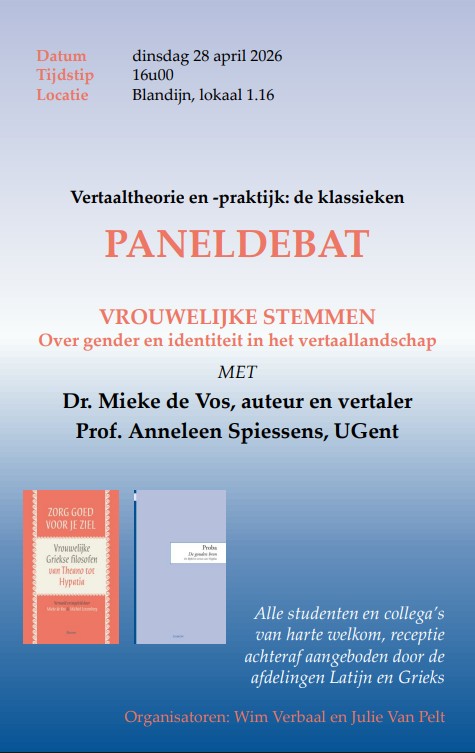
Panel discussion on 28 April: Women’s Voices. On gender and identity in the translation landscape
CfP Journal for Literary and Intermedial Crossings
JLIC: OPEN CALL FOR ARTICLES (2028)
The Journal for Literary and Intermedial Crossings (ISSN 2506-8709) offers an online publication platform to researchers who wish to explore various aesthetic ‘crossings’ concerning media, genres and/or spaces. Targeted squarely at investigating the ‘in-between,’ the journal seeks contributions from scholars broadly covering medial, literary, generic, spatial and cultural crossings that bridge a plurality of potential discourses, modalities, and methodologies. We particularly welcome articles focusing on e.g. intra-, inter- and transmedial phenomena, hypermedia, genre hybridization and mixing, (inter-/cross-)cultural exchange, networks, interactions, contact zones, entanglements, cross-border movements, multilingualism, transnationality, topographies, etc.
The deadline for abstracts is 15 August 2026. Please submit an abstract of maximum 500 words (in English and, if applicable, also in the language of your article, i.e. Dutch, French, German, Italian or Spanish) and a list of 5 keywords (in the same (two) language(s)) and a 100-word author bio (in English only) through the designated form in our submission portal, which can be accessed here.
The deadline for articles is 1 November 2026. We welcome contributions between 5,000 and 6,000 words (references and footnotes included) in Dutch, English, French, German, Italian or Spanish. Potential contributors should bear in mind that a two-stage review process is envisaged for full essays. In the first stage, articles will be reviewed by one of the journal editors. In the second stage, articles will be double-blind peer-reviewed by at least one external anonymous expert referee.
All work submitted to JLIC should reference and be formatted according to our Author Guidelines. JLIC supports textual as well as multi-media formatting. Figures, video and audio files etc. should be saved separately from the text. Articles may be submitted in Word format through the designated form in our submission portal, which can be accessed here.
JLIC considers all manuscripts on the strict condition that:
– the manuscript is your own original work, and does not duplicate any other previously published work, including your own previously published work.
– the manuscript has been submitted only to the Journal of Literary and Intermedial Crossings; it is not under consideration or peer review or accepted for publication or in press or published elsewhere.
– the manuscript contains nothing that is abusive, defamatory, libellous, obscene, fraudulent, or illegal.
– the author has obtained the necessary permission to reuse third-party material in their article. The use of short extracts of text and some other types of material is usually permitted, on a limited basis, for the purposes of criticism and review without securing formal permission. If you wish to include any material in your article for which you do not hold copyright, and which is not covered by this informal agreement, you will need to obtain written permission from the copyright owner prior to submission.