
Oproep tot abstracts: Retranslation in Context VII (Antwerpen, 9–11 december 2026) nodigt uit tot het indienen van voorstellen voor papers van 20 minuten over alle aspecten van hervertaling, met bijzondere aandacht voor contextuele, theoretische, methodologische en nieuwe vraagstukken (waaronder AI). Abstracts (max. 350 woorden + korte bio) dienen uiterlijk 30 juni 2026 te worden ingediend; kennisgeving van aanvaarding volgt uiterlijk 30 september 2026; het voorlopige programma verschijnt tegen 31 oktober 2026. Meer info vindt u hier.
Monthly Archives: april 2026
CfP: Retranslation in Context VII (9-11 December 2026, University of Antwerp)
Call for abstracts: Retranslation in Context VII (Antwerp, 9–11 December 2026) invites 20‑minute paper proposals on any aspect of retranslation, with a special focus on contextual, theoretical, methodological, and emerging issues (including AI). Abstracts (max. 350 words + bionote) are due 30 June 2026; notifications by 30 September 2026; provisional program by 31 October 2026. More info here.
Panel discussion on 28 April: Women’s Voices. On gender and identity in the translation landscape
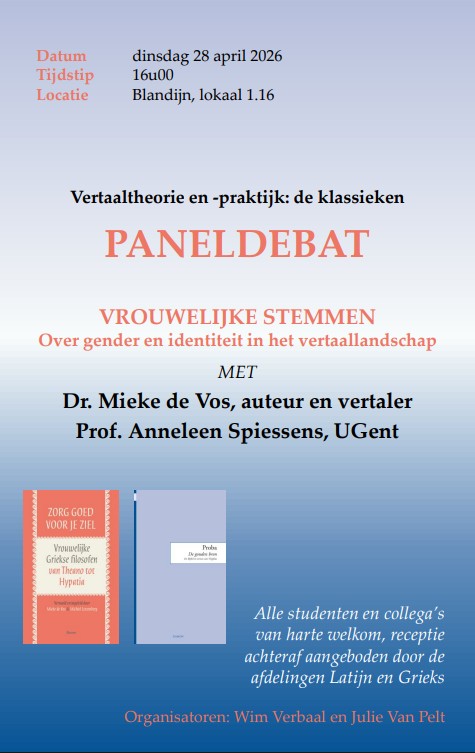
Paneldebat 28 april: Vrouwelijke Stemmen. Over gender en identiteit in het vertaallandschap

CfP Journal for Literary and Intermedial Crossings
JLIC: Open oproep voor artikelen (2028)
Het Journal for Literary and Intermedial Crossings (ISSN 2506-8709) biedt een online publicatieplatform aan onderzoekers die verschillende esthetische ‘kruispunten’ op het gebied van media, genres en/of ruimtes willen verkennen. Het tijdschrift richt zich volledig op het onderzoeken van het ‘tussengebied’ en zoekt bijdragen van wetenschappers die breed ingaan op mediale, literaire, generieke, ruimtelijke en culturele kruispunten die een brug slaan tussen een veelheid aan mogelijke discoursen, modaliteiten en methodologieën. We verwelkomen in het bijzonder artikelen die zich richten op bijvoorbeeld intra-, inter- en transmediale fenomenen, hypermedia, genrehybridisatie en -vermenging, (inter-/cross-)culturele uitwisseling, netwerken, interacties, contactzones, verstrengelingen, grensoverschrijdende bewegingen, meertaligheid, transnationaliteit, topografieën, enz.
De deadline voor abstracts is 15 augustus 2026. Gelieve een abstract van maximaal 500 woorden (in het Engels en, indien van toepassing, ook in de taal van uw artikel, d.w.z. Nederlands, Frans, Duits, Italiaans of Spaans) en een lijst van 5 trefwoorden (in dezelfde (twee) taal(en)) en een biografie van 100 woorden (uitsluitend in het Engels) in te dienen via het daarvoor bestemde formulier op ons inzendingsportaal, dat u hier kunt vinden.
De deadline voor artikelen is 1 november 2026. Wij verwelkomen bijdragen van 5.000 tot 6.000 woorden (inclusief referenties en voetnoten) in het Nederlands, Engels, Frans, Duits, Italiaans of Spaans. Potentiële auteurs dienen er rekening mee te houden dat voor volledige artikelen een peerreview in twee fasen wordt gehanteerd. In de eerste fase worden de artikelen beoordeeld door een van de redacteuren van het tijdschrift. In de tweede fase worden de artikelen onderworpen aan een dubbelblinde peer review door ten minste één externe, anonieme deskundige. Alle bij JLIC ingediende werken moeten verwijzen naar en opgemaakt zijn volgens onze richtlijnen voor auteurs. JLIC ondersteunt zowel tekstuele als multimediale opmaak. Afbeeldingen, video- en audiobestanden enz. moeten apart van de tekst worden opgeslagen. Artikelen kunnen in Word-formaat worden ingediend via het daarvoor bestemde formulier op ons inzendingsportaal, dat hier te vinden is.
CfP Journal for Literary and Intermedial Crossings
JLIC: OPEN CALL FOR ARTICLES (2028)
The Journal for Literary and Intermedial Crossings (ISSN 2506-8709) offers an online publication platform to researchers who wish to explore various aesthetic ‘crossings’ concerning media, genres and/or spaces. Targeted squarely at investigating the ‘in-between,’ the journal seeks contributions from scholars broadly covering medial, literary, generic, spatial and cultural crossings that bridge a plurality of potential discourses, modalities, and methodologies. We particularly welcome articles focusing on e.g. intra-, inter- and transmedial phenomena, hypermedia, genre hybridization and mixing, (inter-/cross-)cultural exchange, networks, interactions, contact zones, entanglements, cross-border movements, multilingualism, transnationality, topographies, etc.
The deadline for abstracts is 15 August 2026. Please submit an abstract of maximum 500 words (in English and, if applicable, also in the language of your article, i.e. Dutch, French, German, Italian or Spanish) and a list of 5 keywords (in the same (two) language(s)) and a 100-word author bio (in English only) through the designated form in our submission portal, which can be accessed here.
The deadline for articles is 1 November 2026. We welcome contributions between 5,000 and 6,000 words (references and footnotes included) in Dutch, English, French, German, Italian or Spanish. Potential contributors should bear in mind that a two-stage review process is envisaged for full essays. In the first stage, articles will be reviewed by one of the journal editors. In the second stage, articles will be double-blind peer-reviewed by at least one external anonymous expert referee.
All work submitted to JLIC should reference and be formatted according to our Author Guidelines. JLIC supports textual as well as multi-media formatting. Figures, video and audio files etc. should be saved separately from the text. Articles may be submitted in Word format through the designated form in our submission portal, which can be accessed here.
JLIC considers all manuscripts on the strict condition that:
– the manuscript is your own original work, and does not duplicate any other previously published work, including your own previously published work.
– the manuscript has been submitted only to the Journal of Literary and Intermedial Crossings; it is not under consideration or peer review or accepted for publication or in press or published elsewhere.
– the manuscript contains nothing that is abusive, defamatory, libellous, obscene, fraudulent, or illegal.
– the author has obtained the necessary permission to reuse third-party material in their article. The use of short extracts of text and some other types of material is usually permitted, on a limited basis, for the purposes of criticism and review without securing formal permission. If you wish to include any material in your article for which you do not hold copyright, and which is not covered by this informal agreement, you will need to obtain written permission from the copyright owner prior to submission.